This week, in the Hesscairn Learning Design Studio, I'm preparing for a session for Education Scotland on the "Know, Do, Understand" curriculum model and how you teach that, and it's a timely reflection, particularly for educators in Scotland who will be moving to this model over the coming years as part of the curriculum improvement cycle. For my doctoral research at Cambridge University, I research conceptualisations of learning and have been working as a technical consultant for the curriculum improvement cycle in Scotland, as well as sitting in on sessions for my research prior to that, as part of my work as a learning designer.
For those who have worked in curriculum design and schools around the world, you'll be aware that the way that cultures and people conceptualise learning varies from system to system. Not only from system to system, but from culture to culture. Learning is a holistic and complex interaction, twined with our physical development, that takes place across a lifetime as we interact with the human, more-than-human, and other-than-human worlds around us. Learning can even change the way our brains develop. For example, Anders Eriksson's research in the Cambridge Handbook of Professional Expertise points out that if children don't learn perfect pitch before around the age of 4 or 5, their brains will develop so they can never learn it. This is the reason why some people used to think it was actually genetic. It's not, but it is an indicator of just how complex the way what we learn, how we learn, and what our culture values are all intertwined.
There are many legitimate ways to conceptualise learning. Any choice you make about what learning is or what model will work for you, for your system and your context, will then determine how you write the curriculum, plan learning, teach, assess, record, and report. The way we conceptualise learning, just like the way we conceptualise happiness or health, is an extremely complex construct that could have many elements depending on what we value. We could think about, spirituality, technical skills, conceptual knowledge, procedural skills, competencies, character, social capital, place-based learning…
The list is almost endless. There isn't a right answer, and cultures vary. For example, for many Māori in New Zealand, the concept of ako is an important part of learning. This is the idea that the learner and the teacher change and transform each other during the process of learning, and that that is an important aspect of learning. In Denmark, for example, in natural language, there is the following taxonomy of learning.
“Firstly, uddannelse includes viden (definitional knowledge, facts), færdigheder (specific technical skills), kompetencer (being able to do something), handlekompetence (being able to actively apply your competencies in real world, practical settings). This is the more technical and institutional side of learning. Secondly, danelse is the other half of learning about becoming yourself and your character. Learning is the coming together of who you are (danelse) and what you do in the world (uddannelse).” (MacAlpine, 2026)
The word "learning" itself is hard to define, as can be seen from Illeris’' book, "Contemporary Theories of Learning." (Illeris, 2008) in which, effectively, we end up with the conclusion that we know it when we see it. Indeed, in English, the word "learning" itself is actually a metaphor, and it comes from the Proto-Germanic word lisnojanan which means to follow a path, very similar to the Latin origins of curriculum, which means a path you run along. Perhaps Romans were in more of a hurry.
So the point is, the construct we choose of learning is an expression of what we value, rather than some transcendent truth. I normally conceptualise learning with the following taxonomy I developed for the Hesscairn Guide to Learning and as a result of working in curriculum development across a wide range of settings in refugee education, high-performing systems like Singapore, international contexts, and working for organisations like the LEGO Foundation on learning grants across the world, as well as my doctoral research at Cambridge University on learning design.
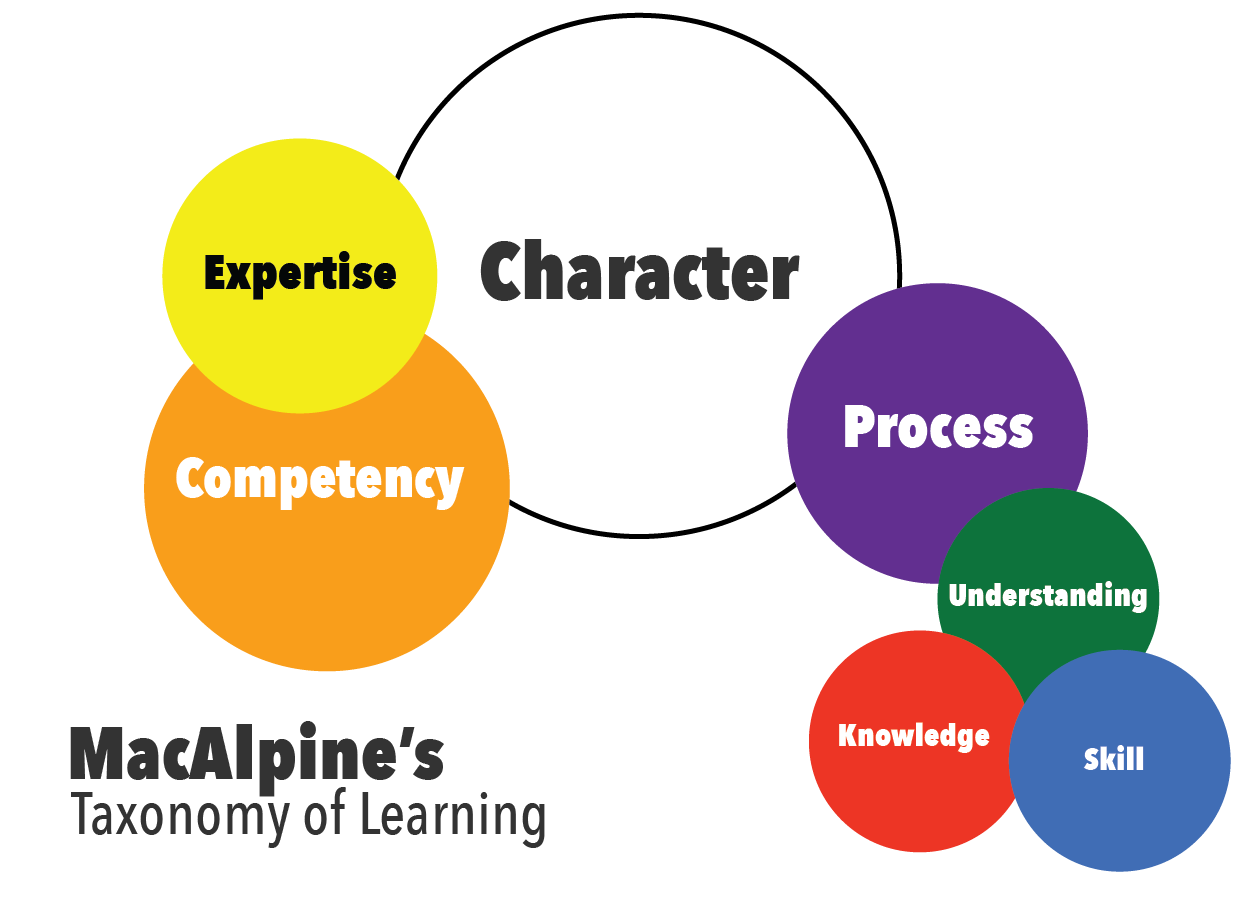
MacAlpine's taxonomy of learning
To find out more about this, you can purchase the Hesscairn Guide to Learning, which is a comprehensive overview of theories of learning and the ways in which you can use these to design and implement learning programmes.
Following the OECD's recommendations in its review of the Curriculum for Excellence, and a national consultation process, Scotland decided to adopt a "know, do, understand" model of education. This has a number of advantages, which directly address some of the feedback on the Curriculum for Excellence, but also fit well with Scotland's aspirations as a country. It relates to things like the importance of autonomy within the system, as a country that has a particular history that means it values freedom and autonomy particularly highly, as well as having high levels of trust in the teaching profession.
Other aspects of the taxonomy of learning above are covered in areas such as the four capacities, which remain from the Curriculum for Excellence. These are ways in which aspects of character and competency can be developed. Additionally, in wider achievement, areas of personal expertise and deliberate practise are also nurtured. When looking at Scotland's model, I see quite comprehensive coverage of what I would consider a basic taxonomy of learning.
What is a know-do-understand model?
There are many ways in which we can create taxonomies of learning. In a "know, do, understand" model, the distinctions are the following: Knowledge (know) is defined in this case as definitions, case studies, and examples. This is obviously not the only way you can define knowledge, and for some people, all of learning is knowledge, and for some, it's limited to this. In a know-do-understand model, that's how we use the word. What this means is it's useful to learn and know case studies and examples because they provide the foundation for understanding.
Understanding is when we begin to extract patterns and relationships. These are normally understood as concepts, which are abstract labels for a group of phenomena or objects that share properties. For example, ‘complex systems’, ‘literary features’, ‘fiscal policies’ or ‘large language models’. In one sense, you could say that all nouns are concepts because all of them are an abstract group based on shared attributes. But people often think of concepts as the more abstract, lofty, and transferable concepts. There is considerable research on concept formation and recognition in a number of branches of psychology and philosophy, particularly; much of my doctoral research is around exploring different ways in which people conceptualise learning itself and, within this, the different ways they understand how concepts are formed and what they are. There are some interesting distinctions, such as that there is reasonable evidence that there are natural concepts that people tend to form, such as trees, even though, intellectually, it's quite hard to distinguish, say, trees from shrubs categorically, yet children tend to naturally do this without too much prompting. And then there are artificial concepts that didn't exist until we invented them, such as ‘circuit boards’ or ‘economic inflation’. An understanding is normally expressed in a "know-do-understand" model as two (or more) concepts joined by a verb. That means an understanding of how two types of objects relate to each other. This relationship can be in many forms. It might be causal: that one thing causes another to happen. It might be correlational, it might be about one being a sufficient and/or necessary condition for another thing to happen, it might be that one thing predicts another or makes it more likely. Here are some examples of understanding statements from the forthcoming curriculum. All of these are publicly available from Education Scotland.
Here is a quite process-focused understanding from the science curriculum:
Evaluating scientific practice involves considering the strengths and limitations of the method, results, and conclusion, supporting more accurate and reliable findings in future investigations.
Here is an understanding of story from the Literacy and English curriculum.
Selecting and creating texts for personal purpose and enjoyment empowers and enriches understanding of ourselves, others and the wider world.
In the model, these understandings will build upon specific knowledge, which will help highlight or illuminate this relationship. The understanding is the abstraction of the pattern that transfers across and between examples and makes sense of them.
Skills work very similarly to knowledge. Skills in a know-do-understand model would be defined as specific, discrete actions that belong to the curriculum area. That could be anything from conducting an experiment in science, to recording data in maths to analysing the use of imagery in English. The skills and knowledge work together in concrete locations and for specific tasks, and the abstraction in the understanding identifies the pattern that transfers or makes meaning of the examples.
Why is a "know, do, understand" model useful?
As we've said before, no model of learning is objectively true. They are either useful or not. Or perhaps more accurately, they are either more useful than another model or less useful than it for your goals and context. Learning has always involved the whole taxonomy that we described above. All that a specific learning model does is highlight and focus on particular aspects of it because they find those are useful intervention points when thinking about planning, teaching, assessing, recording, and reporting.
To understand why this particular model is useful, it helps to understand the circumstances in which it was developed and what problem it was trying to solve. The birth of the modern know-do-understand model is a result of the thinking of Alec Peterson (born in Edinburgh, so Scotland can claim him), who took a sabbatical from the Department of Education at Oxford University in order to write a curriculum for a new scholarship-based international boarding school with a mission for peace that Kurt Hahn (who was up in Moray founding Gordonstoun and about to set up Atlantic college in Wales, so we can tentatively claim him too) was engaged with. This eventually became the United World Colleges. Hahn’s problem that he asked Peterson to solve was that students from different countries both came with different kinds of knowledge and would, in future, require different kinds of knowledge to work within the societies that they came from or would eventually live in. So how can you have a coherent curriculum with a strong knowledge component that also allows for that?
The answer that Peterson came up with was to teach what he called "mankind's main tools of thought." Which we would call humans' main tools of thought. By teaching paradigms of how humans in different curriculum areas understand and make sense of the world, the knowledge then becomes illustrative of those conceptual relationships and ideas. So, for example, maths works deductively through reasoning and logic based on premises and axioms. Science works inductively based on empirical evidence. The arts tend to think abductively in terms of interpretation (thinking about what might be the best possible interpretation given our own perspective) and also use intuitive and emotional responses in the creation and evaluation of art. Each of these contributes a unique way of thinking and a unique epistemology, and each comes with a large body of knowledge and skill that sit under those understandings. By articulating the understandings, knowledge can be selected which illustrates them. The power of this is that knowledge is both explicit and clear, but there is also flexibility around which precise case studies are chosen. So, for example, whilst you might agree that you're going to study industrialisation, either the teacher or the individual students could look at the particular dynamics and mechanisms by which an industrial revolution took place in a given context. There is an understanding about the way in which industrialization involves specialisation and concentration of labour and materials, and the economic benefits this brings, alongside often environmental concerns and well-being concerns. But the exact context of each person's case study can vary. And this, in fact, brings richness because we know from research in psychology that the more examples of a concept or a conceptual understanding a learner is exposed to, the stronger the schema or the more nuanced the understanding becomes. For example, we start adding qualifiers related to under what conditions the relationship holds true, when it breaks down, and whether there are limits of that relationship.
It also has other benefits. It strengthens critical thinking and can strengthen things like collaboration, care, and a sense of agency and autonomy if it's taught in an appropriate way. The vast global success of the International Baccalaureate programme that Peterson designed with this thinking is an indication of the success of this model when it's done well.
Why is that a useful model for Scotland?
Scotland has a unique and rich educational tradition, with some startling contributions to intellectual and academic history, not limited to but certainly epitomised by the Scottish Enlightenment that spawned such incredible thinkers as Adam Smith and David Hume. Indeed, Winston Churchill said “Of all the small nations of this earth, perhaps only the ancient Greeks surpass the Scots in their contribution to mankind.” Part of this rich tradition is a culture of respecting both communities' rights to determine the learning they value and a respect for the professional status and autonomy of teachers within their schools and their communities.
This sets up a paradox for curriculum writers. On the one hand, a clear curriculum from the centre gives the kind of clarity that makes planning and assessment more straightforward. If you leave learning goals vague, you create hundreds of thousands of hours of work, perhaps even millions, of moderation on checking uncertainty and quality control because the goals themselves are too vague. On the other hand, if you prescribe them tightly to specific knowledge and skill, you tie educators' hands in their ability to create relevant learning for their community and classes and respond to the interests, needs, and enthusiasms of the learners that they work with (or, indeed, to reflect the learning that their specific community values). So, what to do?
This explains the OECD's recommendation of a "know, do, understand" model. There was recognition that the Curriculum for Excellence had created a curriculum that was vague in some senses at the basic operational level of what is taught in classrooms, whilst having a very good framework for the more aspirational elements of learning. Leaving it vague wasn't an option, but in a country that values localization, contextualization, and teacher autonomy, nailing down a rote learning curriculum from the centre was also not an option. This curriculum has to both provide clarity and autonomy, and inspiration across a country that encompasses modern, dynamic, large urban centres like Glasgow and small rural island communities with living connections that go back thousands of years to the landscape that was left when the glaciers withdrew .
A know-do-understand model is perfect for this, for the same reasons why it works in refugee contexts and in international schools. There can be complete clarity about what the transferable and life-worthy understandings are that learners will use to make sense of the world. There can be complete clarity about the types of knowledge and skill that are required at different levels. At the same time, because the knowledge is used to contribute towards the understanding and is illustrative of it, there can be choice about the exact case studies or examples in most cases. Therefore, the curriculum can closely guide teachers to choose or find examples that are relevant to their learners, but at the same time not leave that vague about what is supposed to be happening in the classroom. And the curriculum, of course, doesn't prescribe everything that happens in a classroom or in learning. It is just the common shared base.
In Scotland, the model is summarised in the following graphic, designed by the team at Education Scotland, which I find powerful and useful.
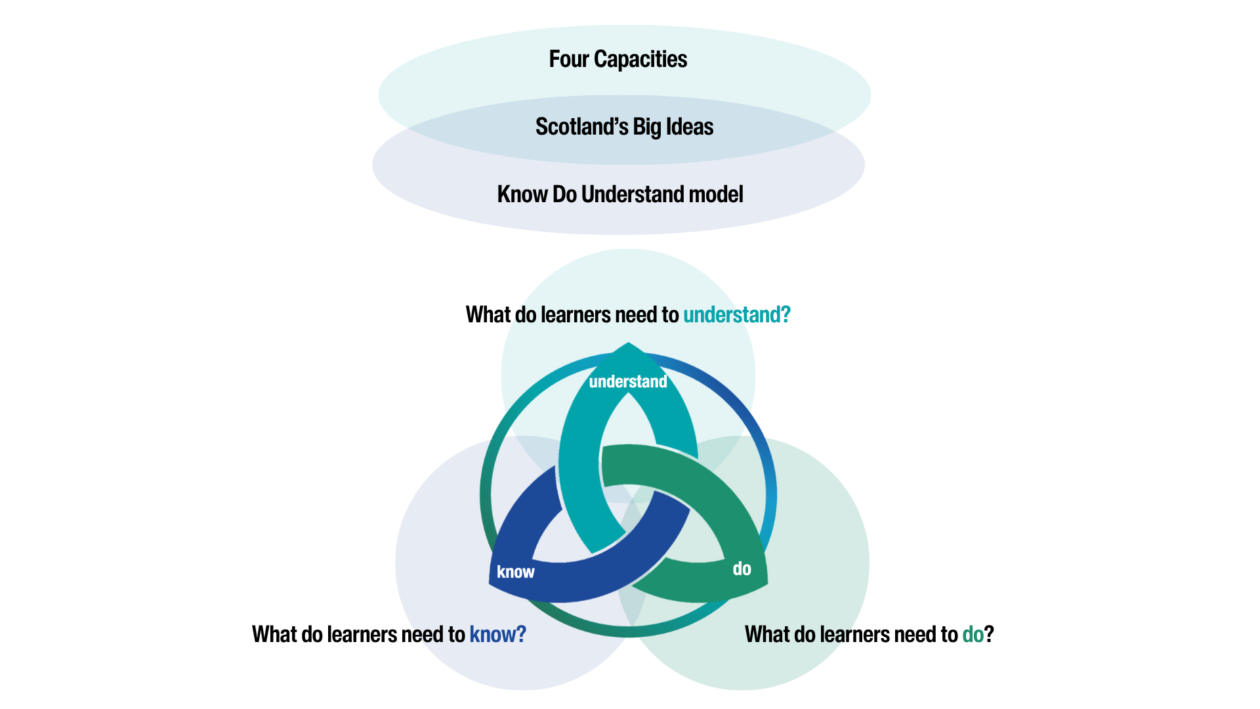
A particularly effective part of this graphic is the way that the Celtic knot not only is a reminder of Scotland's indigenous culture and history but also emphasises the way in which the know, do, and understand are intimately interrelated and combined.
So how do you teach that?
Each kind of learning comes with its own pedagogy that is well matched to the understanding and construct of learning. Models that emphasise the forming of conceptual understandings, (which can also be called a wide range of other things, schema, ideas, abstractions, theories, etc.) All tend to follow the same basic pattern. A bit like Joseph Campbell's book, A Hero with a Thousand Faces, which points out that almost every protagonist goes through the same cycle. So too, almost every constructivist or understanding-based approach to learning follows the same basic pattern. I articulated the pattern in the following way.

For learners to connect concepts, they first have to recognise them. Often, the recognition of a concept (such as a closed loop, a mammal, or a metaphysical conceit in English) is not a thing that learners will naturally recognise, and it relies heavily on knowledge and skill. Likewise, if you're working in a skill-heavy area like PE and you want to work on breaking the line of defence in an invasion game, learners first have to know what a line of defence is and what an invasion game is. Both of these are abstract concepts, and both of them require knowledge to ground what that concept is and what we're talking about when we talk about them. This is the awareness stage. Normally, the first part of learning is driven by recognising and interrogating particular phenomena, looking at case studies, learning examples, and learning to recognise what's happening. This requires selective attention, managing cognitive load, and being very careful about what you draw attention to. It also explains why one of the archetypal teachers' tools from the first age of teaching was a pointing stick for the blackboard. It's about managing and drawing attention and curiosity to particular aspects of phenomena.
There are many ways to do this through immersion into tools such as Freyer models, concept lines, etc. In my book, The Hesscairn Guide to Teaching for Understanding, you'll find a wide range of tools that you can readily use for this stage of the learning. You can get the book from Ingrove Press here.
The next stage of learning is beginning to look at how those things are related. How does moving into space help you break the line of defence? How do literary features such as transferred epithets or metaphysical conceits create a subtext within a poem? What the learner is effectively learning to do is abstract their understanding from the specific context of the exact examples they have been looking at to begin to think about how they will apply that to other examples in the future. This is the essence of learning for understanding.
Once they have done that in the abstraction phase, using tools such as retrieval charts, causality diagrams, etc., the teacher's job is to then get them to test out their ideas. Just as scientists have developed a limitless number of theories (which, when tested back against the real world, turned out not to be quite true or needed amending), so too most of learners' initial ideas won't be quite right. An important part of constructivist learning is to ask them to apply their ideas to new case studies or examples, and then see if they need to qualify their ideas. For example, do poets always use imagery to create a subtext in poems? Does breaking the line of defence always involve creating space between defenders, or are there other ways of breaking it, such as passing over the top or going around the outside? The benefit of this is that not only are you strengthening their knowledge and skill, but you're also strengthening both their conceptual schema and their flexibility of thinking, and their ability to critically reason and apply learning.
What’s the + for?
One of the limitations of many of the models for concept-based learning (which normally follow the three-step pattern of awareness, abstraction, application) is that they forget that just because you understand something and have some knowledge and skill doesn't necessarily mean you're any good at it. Whilst I might have an excellent understanding of how to play snooker or pool and a really good understanding of the angles that are created between balls, I'm not a particularly good pool player. Likewise, I can understand the importance of creating a topspin forehand in order to create power and a high bounce that will make it hard for my opponent to reply in tennis. The fact is, I'm not a very good tennis player. The deliberate plus is a reminder of the significant and extensive research on the nature of how expertise is developed through deliberate practise and feedback. This applies as well to mathematical problem solving as it applies to elite tennis. By including this in the model and giving learners an opportunity for deliberate practise, we create a rich learning environment with:
secure foundations in knowledge and skill
a strong link to understanding, so they can use that knowledge and skill in varied settings and critically think effectively within the curriculum area or outside it
opportunities for them to practise and get better
This is what the AAA+ model is articulating.
Thoughts on what is ahead for Scotland
There can be a lot of heat and noise about educational models, particularly in recent times, that I find unedifying and unnecessary. I often think of Yeats's line in "The Second Coming": "The worst are full of passionate certainty." The truth is that learning has always been a rich, multiple-dimensional construct that we don't really understand as a whole, but we know it when we see it. We also recognise how intimately it's tied up with relationships, culture, development, and the way in which children see adults and we see each other. It's tied up with our aspirations as humans and as cultures, and the way we want to live in and with the world around us. The "know, do, understand" is just a small part of a wider taxonomy of learning. The question is whether this helps us as teachers?
In the light of this and in my work with children in refugee settings (such as Amala/Sky School), the United World Colleges, Green School New Zealand, working at the Lego Foundation, and working in many schools at different stages of my career in various capacities I feel confident that Scotland has chosen a really outstandingly useful and effective model for curriculum that will support the kind of teaching and learning I see my colleagues in Scotland aspiring to. They want less time moderating unclear learning goals and not to have to work so hard to make the curriculum make sense. I think this provides that, and the new model is much, much clearer. At the same time, I don't want to be reverting back to Dickens's Hard Times and rote fact memorization - as the modern world so clearly requires more flexible thinking than that. What I do want is a curriculum that allows me to make meaningful connections to case studies and examples that can be mirrors, windows, and sliding doors for the learners in front of me. That will inspire them and motivate them. I want them to make sense of the world.
In a computing lesson I was in earlier this week and had to cover for a colleague, I noticed they were introducing the parts and definitions of computational thinking and concepts such as decomposition. They were doing this before moving on towards an understanding of how these parts of the process and these skills can be combined to do complex problem solving, both in digital and analogue settings. I saw them asking learners to transfer this to different aspects of their life (from cooking to friendships) and think about to what extent they use those skills and those processes to solve problems. I saw them being asked to practise that in a number of new contexts, case studies, or programming languages. This was an archetypal example of the AAA+ model and the know-do-understand model of curriculum.
The point I'm making is that perhaps the new model of curriculum isn't new in the sense of demanding an entirely new set of behaviours or pedagogies. What it brings is greater clarity, and what it brings is a vocabulary to talk about our practise, examine it, refine and improve it with a shared language. So what lies ahead for Scotland, I don't think, is a radical change of model, but rather building and sharing a shared language for how we think about one particular part of the taxonomy of learning (and how we think about how you plan, teach, assess, record, and report that).
There is more than one way….
A final thought from me is that these models were first developed in the 1960s and 1970s, and they're still incredibly useful today. I think Scotland is incredibly progressive educationally as a nation, even whilst it might struggle with the economies of implementation and system capacity. I applaud the efforts that are going on to create a really meaningful and thoughtful curriculum for young people that really has been through a co-constructed process with the profession. It's laudable in every sense.
But back to Nietzsche and our understanding of models: it's not the only way you can understand learning. Although I love supporting the curriculum improvement cycle and working in a technical capacity on it, I'm also always mindful that there are so many rich perspectives we can also be embracing and exploring simultaneously. Post-humanist perspectives and ecological perspectives can bring such incredible richness to our understanding of what it means to be a child who is learning in a particular environment. Working in the Highlands, where the landscape has such a powerful impact on all aspects of being and learning, I'm fascinated to explore what Highland and post-human pedagogies might entail. As part of the Hesscairn Learning Design Studio, I would just like a caveat that there is more than one way of doing learning. So whilst I hope that Scotland wholeheartedly embraces the know-do-understand model that has been decided by its people and government, I also hope that it never finds itself in an ossified position where there is only one right way of understanding learning. The joy of learning, just like the joys of love, friendship, and families, is that there are many ways of doing it wonderfully, and they're all valid if they work for you and you have reason to value them. As my friend Ben Mardell says, ‘There is more than one way’.
Further reading
If you're interested in concepts, understanding, and constructive learning, I'd recommend the following books. I've tried to create a really accessible guide to teaching for understanding and constructs of learning, following my work at the LEGO Foundation, where I felt this was a real gap in the following two books. They're both available for at Ingrove Press. They are also available on Amazon etc, but are slightly more expensive there, and you will get a better service direct from the publisher. Email me if you want bulk orders, and I can arrange for a discount if what you're doing is aligned to the work in Scotland or partner organisations internationally
MacAlpine, S. M. (2026a). AAA+ The Hesscairn Guide to Teaching for Understanding: How to Teach Big Ideas. Ingrove Press.
MacAlpine, S. M. (2026b). The Hesscairn Guide to Learning: Transforming Education: The essential learning guidebook for parents, educators, grant and policy makers. Ingrove Press.
If you're interested in concepts and conceptual understanding, the following books are illuminating. Some of them are quite academic. I'll also include some of the books on expertise.
For a comprehensive overview of conventional contemporary thinking about conceptualization, concepts, and understanding, the best guide, if you're not looking for a post-human angle, is Margolis, Eric, and Stephen Laurence, eds. 1999. Concepts: Core Readings. Cambridge, Mass.: MIT Press.
Other books that will interest you if you're interested in concepts and learning are in my view…
Aristotle. [330 AD] 1998. The Metaphysics. edited by H. Lawson-Tancred. Penguin Classics. London: Penguin Books.
Aristotle. [330 AD] 2000. The Categories. Project Gutenberg.
Ausubel, David Paul. 1963. The Psychology of Meaningful Verbal Learning: An Introduction to School Learning. New York: Grune & Stratton.
Barad, Karen. 2007. Meeting the Universe Halfway: Quantum Physics and the Entanglement of Matter and Meaning. Duke University Press.
Barnes, Jonathan. [470 AD] 2001. Early Greek Philosophy. London ; New York: Penguin Classics.
Bloom, Paul. 2001. ‘Children Learn the Meanings of Words’. Behavioral and Brain Sciences 24(6):1095–1103. doi:10.1017/s0140525x01000139.
Borghi, Anna M. 2022. ‘Concepts for Which We Need Others More: The Case of Abstract Concepts’. Current Directions in Psychological Science 31(3):238–46. doi:10.1177/09637214221079625.
Borsboom, Denny, Gideon J. Mellenbergh, and Jaap van Heerden. 2004. ‘The Concept of Validity’. Psychological Review 111(4):1061–71. doi:10.1037/0033-295X.111.4.1061.
Bruner, Jerome S., Jacqueline J. Goodnow, and George A. Austin. 1986. A Study of Thinking. Social Science Classics Series. New Brunswick, N.J., U.S.A: Transaction Books.
Bubner, Rudiger. 1997. German Idealist Philosophy. London: Penguin Classics.
Burns, Marion, Lynn Taylor, and Liz Paterson. 2020. Realising the Ambition: Being Me. Livingston, Scotland: Education Scotland.
Carey, Susan. 2004. ‘Bootstrapping & the Origin of Concepts’. Daedalus 133(1):59–68. doi:10.1162/001152604772746701.
Carey, Susan. 2009. The Origin of Concepts. Oxford University Press.
Cronbach, Lee J., and Paul E. Meehl. 1955. ‘Construct Validity in Psychological Tests’. Psychological Bulletin52(4):281–302. doi:10.1037/h0040957.
Deleuze, Gilles. [1962] 2006. Nietzsche and Philosophy. Continuum Impacts. London ; New York: Continuum.
Deleuze, Gilles. [1981] 2007. Spinoza: Practical Philosophy. San Francisco, Calif: City Lights Books.
Deleuze, Gilles, and Félix Guattari. [1991] 1994. What Is Philosophy? Verso.
Deleuze, Gilles, and Félix Guattari. [1980] 2013. A Thousand Plateaus: Capitalism and Schizophrenia. edited by B. Massumi. Bloomsbury Revelations Series. London New York Oxford New Delhi Sydney: Bloomsbury Academic.
Dernikos, Bessie, Nancy Lesko, Stephanie McCall, and Alyssa Niccolini, eds. 2020. Mapping the Affective Turn in Education: Theory, Research, and Pedagogy. New York: Routledge.
Derrida, Jacques. [1972] 1982. Margins of Philosophy. Chicago: University of Chicago Press.
Derrida, Jacques. [1967] 1998. Of Grammatology. Corrected ed. Baltimore: Johns Hopkins University Press.
Derrida, Jacques. [1967] 2010. Writing and Difference. Transferred to digital print. 2006, repr. Routledge Classics. London: Routledge.
Derrida, Jacques. [1972] 2016. Dissemination. Bloomsbury Academic.
Dolphijn, Rick, and Iris van der Tuin. 2012. New Materialism: Interviews and Cartographies. Open Humanities Press.
Donaldson, J., and Ayana Allen-Handy. 2020. ‘The Nature and Power of Conceptualizations of Learning’. Educational Psychology Review 32(2):545–70. doi:10.1007/s10648-019-09503-2.
Education Scotland. 2024a. ‘Curriculum Improvement Cycle (CIC): Background and a Case for Change: Findings from the Pilot Curriculum Reviews 2023/24: A Discussion Paper: November 2024’.
Education Scotland. 2024b. ‘Curriculum Improvement Cycle (CIC): Towards an Evolved Technical Framework: A Discussion Paper’.
Education Scotland. 2025. ‘Curriculum Improvement Cycle (CIC): Working Together to Make Change Happen: A Discussion Paper’.
Edwards, Carolyn, Lella Gandini, and George Forman. 2012. The Hundred Languages of Children: The Reggio Emilia Experience in Transformation. Santa Barbrara, Calif: Praeger.
Farmer, Stuart. 2024. ‘Moving from Transmissive to Transformative: Closing the Policy‐practice Gap in Teacher Professional Learning in Scotland’. The Curriculum Journal 35(4):724–26. doi:10.1002/curj.289.
Fodor, Jerry A. 2000. The Mind Doesn’t Work That Way: The Scope and Limits of Computational Psychology. The MIT Press.
Foucault, Michel. 1977. Language, Counter-Memory, Practice: Selected Essays and Interviews. edited by D. F. Bouchard. Ithaca, NY: Cornell University Press.
Foucault, Michel. [1970] 2007. The Order of Things: An Archaeology of the Human Sciences. London: Routledge.
Gale, Ken. 2018. Madness as Methodology: Bringing Concepts to Life in Contemporary Theorizing and Inquiry. London New York: Routledge, Taylor & Francis Group.
Goddard, Roy. 2009. ‘Not Fit for Purpose: The National Strategies for Literacy Considered as an Endeavour of Government’. Power and Education 1(1):30–41. doi:10.2304/power.2009.1.1.30.
Goldman, Alvin I. 2006. Simulating Minds: The Philosophy, Psychology, and Neuroscience of Mindreading. 1st edn. Oxford University PressNew York.
Goldstone, Robert L., and Alan Kersten. 2003. ‘Concepts and Categorization’. Pp. 597–621 in Handbook of Psychology. John Wiley & Sons, Ltd.
Gopnik, Alison. 1999. The Scientist in the Crib: Minds, Brains, and How Children Learn. New York: William Morrow & Co.
Haraway, Donna. 2012. The Companion Species Manifesto: Dogs, People, and Significant Otherness. 6th print. Paradigm. Chicago, Ill: Prickly Paradigm Press.
Haraway, Donna. [1991] 2013. Simians, Cyborgs, and Women: The Reinvention of Nature. 1st edition. United Kingdom: Routledge.
Haraway, Donna. 2016. Staying with the Trouble: Making Kin in the Chthulucene. Illustrated edition. Experimental Futures Technological Lives, Scientific Arts, Anthropological Voices. Durham London: Duke University Press.
Haraway, Donna. [1985] 2022. ‘17. “The Promises of Monsters: A Regenerative Politics for Inappropriate/d Others”’. Pp. 314–66 in Cybersexualities: A Reader in Feminist Theory, Cyborgs and Cyberspace. Edinburgh University Press.
Harman, Graham. 2018. Object-Oriented Ontology: A New Theory of Everything. London: Pelican.
Harvard GSD, dir. 2019. Rosi Braidotti, “Posthuman Knowledge”.
Hutchins, Edwin. 2006. Cognition in the Wild. 8. pr. A Bradford Book. Cambridge, Mass.: MIT Press.
Illeris, Knud, ed. 2009. Contemporary Theories of Learning: Learning Theorists -- in Their Own Words. 1st edn. London ; New York: Routledge.
Introduction: What makes science possible? 2002. Pp. 1–20 in The Cognitive Basis of Science. Cambridge University Press.
Jackson, Zakiyyah Iman. 2020. Becoming Human: Matter and Meaning in an Antiblack World. Sexual Cultures. New York: New York University Press.
Kane, Michael T. 2013. ‘Validating the Interpretations and Uses of Test Scores’. Journal of Educational Measurement50(1):1–73. doi:10.1111/jedm.12000.
Lakoff, George, and Mark Johnson. 2003. Metaphors We Live By. Chicago: University of Chicago Press.
Latour, Bruno, and Catherine Porter. 2004. Politics of Nature. Harvard University Press.
Leopold, Aldo. [1949] 2020. A Sand County Almanac & Other Writings on Ecology and Conservation. The Library of America. Penguin Classics.
Leslie, Alan M. 1987. ‘Pretense and Representation: The Origins of “Theory of Mind”’. Psychological Review94(4):412–26. doi:10.1037/0033-295X.94.4.412.
Leslie, Alan M., Rochel Gelman, and C. R. Gallistel. 2008. ‘The Generative Basis of Natural Number Concepts’. Trends in Cognitive Sciences 12(6):213–18. doi:10.1016/j.tics.2008.03.004.
Lord, Frederic M., and Melvin R. Novick. 1968. Statistical Theories of Mental Test Scores. Addison-Wesley Series in Behavioral Science: Quantitative Methods. Reading, MA: Addison-Wesley.
MacCorquodale, Kenneth, and Paul E. Meehl. 1948. ‘On a Distinction between Hypothetical Constructs and Intervening Variables’. Psychological Review 55(2):95–107. doi:10.1037/h0056029.
Mardell, Ben. 2023. A Pedagogy of Play. Harvard Project Zero.
Markus, Keith A., and Denny Borsboom. 2013. Frontiers of Test Validity Theory: Measurement, Causation, and Meaning. Multivariate Applications Series. New York, NY: Routledge.
Maxwell, Joseph Alex. 2012. A Realist Approach for Qualitative Research. Los Angeles, Calif. ; SAGE.
McFlynn, Paul, Mairead Davidson, Clare McAuley, and Sammy Taggart. 2024. ‘Fulfilling the Unmet Potential: Harnessing Ambition, Autonomy, and Agility in Northern Ireland’s Education System’. The Curriculum Journal35(4):637–51. doi:10.1002/curj.282.
Meadows, Donella H. 2008. Thinking in Systems. Illustrated edition. edited by D. Wright. White River Junction, Vt: Chelsea Green Publishing.
Menzies, Loic. 2026. How Policy Happens: Understanding the Decisions That Shape Our Education Systems. London: Routledge.
Messick, Samuel J. 1989. ‘Validity’. Pp. 13–103 in Educational measurement, edited by R. L. Linn. New York, NY: American Council on Education and Macmillan.
Mislevy, Robert J., Russell G. Almond, and Janice F. Lukas. 2003. A Brief Introduction to Evidence-Centered Design. ETS Research Report. RR-03-16. Princeton, NJ: Educational Testing Service. doi:10.1002/j.2333-8504.2003.tb01908.x.
Monett, Dagmar, and Gilbert Paquet. 2025. ‘Against the Commodification of Education—If Harms Then Not AI’. Journal of Open, Distance, and Digital Education 2(1):1–24. doi:10.25619/wazgw457.
Murris, Karin. 2020. Navigating the Postqualitative, New Materialist and Critical Posthumanist Terrain across Disciplines: An Introductory Guide. Vol. 1. 1st edition. Postqualitative, New Materialist and Critical Posthuman Research Research. United Kingdom: Routledge.
Murris, Karin. 2021. A Glossary for Doing Postqualitative, New Materialist and Critical Posthumanist Research across Disciplines. 1st edn. Postqualitative, New Materialist and Critical Posthuman Research Research. United Kingdom: Taylor & Francis.
Murris, Karin, and Vivienne Bozalek. 2019. ‘Diffracting Diffractive Readings of Texts as Methodology: Some Propositions’. Educational Philosophy and Theory 51(14):1504–17. doi:10.1080/00131857.2019.1570843.
Nietzsche, Friedrich. [1883] 1961. Thus Spoke Zarathustra: A Book for Everyone and No One. Repr. with new chronology. edited by R. J. Hollingsworth. Penguin Classics. London: Penguin Books.
Nietzsche, Friedrich Wilhelm. [1886] 2003. Beyond Good and Evil: Prelude to a Philosophy of the Future. edited by R. J. Hollingdale. Penguin Classics. London ; New York: Penguin Books.
Nietzsche, Friedrich Wilhelm. [1887] 2013. On the Genealogy of Morals. London: Penguin Books.
Novak, Joseph D. 2010. Learning, Creating, and Using Knowledge: Concept Maps as Facilitative Tools in Schools and Corporations. 2. ed. New York, NY: Routledge.
OECD. 2018. ‘The Future of Education and Skills 2030: The Future We Want’.
OECD. 2019. OECD Learning Compass 2030 Concept Note Series. Concept note series. OECD. https://www.oecd.org/content/dam/oecd/en/about/projects/edu/education-2040/1-1-learning-compass/OECD_Learning_Compass_2030_Concept_Note_Series.pdf.
OECD. 2021. Scotland’s Curriculum for Excellence: Into the Future. Implementing Education Policies. OECD.
Organisation for Economic Co-operation and Development (OECD). 2020. ‘Curriculum Overload’.
Pellegrino, James W., Naomi Chudowsky, and Robert Glaser, eds. 2001. Knowing What Students Know: The Science and Design of Educational Assessment. Washington, DC: National Academies Press.
Philippou, Stavroula, and Vassilis Tsafos. 2024. ‘Recontextualising Stenhouse: Instantiations of the “Teacher as Researcher” Metaphor in Greece and Cyprus’. The Curriculum Journal 35(4):567–85. doi:10.1002/curj.286.
Piaget, Jean. [1929] 2011. The Child’s Conception of the World. London: Routledge.
Pinar, William F. 2019. What Is Curriculum Theory? 3rd edn. Studies in Curriculum Theory Series. New York, NY: Routledge.
Plato. [375 AD] 2011. The Republic. 3rd edition. edited by M. S. Lane and R. Kamtekar. London, England: Penguin Books.
Prideaux, Sue. 2018. I Am Dynamite! A Life of Friedrich Nietzsche. Main. London: Faber & Faber.
Priestley, Mark, Corinne Angier, Barbara Schuler, and Joseph Smith. 2025. ‘Towards a Typology of Curriculum Approaches’ edited by Y. Ydo and L. Ji.
Printer, Liam. 2024. ‘Towards a Motivating Language Acquisition Curriculum’. The Curriculum Journal 35(4):727–31. doi:10.1002/curj.287.
Quine, W. V. 1968. ‘Ontological Relativity’. The Journal of Philosophy 65(7):185–212. doi:10.2307/2024305.
Quine, Willard Van Orman. 2013. Word and Object. New edition., New edition. edited by P. S. Churchland and D. Follesdal. The MIT Press. The MIT Press.
Rasch, Georg. 1960. Probabilistic Models for Some Intelligence and Attainment Tests. Vol. 1. Studies in Mathematical Psychology. Copenhagen, Denmark: Danish Institute for Educational Research.
Reynolds, Alex, Hannah Heron, Kirstin Mulholland, Louise Jackson, and Nicola Cherry. 2023. ‘Lightening the Load: Integrating Cognitive Load, Schema Theory and Progression Mapping in the Primary Classroom’. https://my.chartered.college/impact_article/lightening-the-load-integrating-cognitive-load-schema-theory-and-progression-mapping-in-the-primary-classroom/.
Rizvi, Fazal, and Bob Lingard. 2009. Globalizing Education Policy. Oxford, UNITED KINGDOM: Taylor & Francis Group.
Rogerson, Kirsty. 2022. ‘Is Schema Theory the Answer to Gaps in Knowledge for Both Students and Staff?’ https://my.chartered.college/impact_article/is-schema-theory-the-answer-to-gaps-in-knowledge-for-both-students-and-staff/.
Rosch, Eleanor, Carolyn B. Mervis, Wayne D. Gray, David M. Johnson, and Penny Boyes-Braem. 1976. ‘Basic Objects in Natural Categories’. Cognitive Psychology 8(3):382–439. doi:10.1016/0010-0285(76)90013-x.
Schiro, Michael. 2013. Curriculum Theory: Conflicting Visions and Enduring Concerns. 2nd ed. Los Angeles, Calif: SAGE Publications.
Sen, Amartya. 1999. Development as Freedom. Oxford New york: Oxford University Press.
Sengeh, David, and Rebecca Winthrop. 2022. Transforming Education Systems: Why, What, and How. Policy brief. Brookings Institution. https://www.brookings.edu/wp-content/uploads/2022/06/Brooking_2-Pager_FINAL.pdf.
Shepard, Lorrie A. 2000. ‘The Role of Assessment in a Learning Culture’. Educational Researcher 29(7):4–14. doi:10.3102/0013189X029007004.
Sireci, Stephen G. 2007. ‘On Validity Theory and Test Validation’. Educational Researcher 36(8):477–81. doi:10.3102/0013189X07311609.
Sloutsky, Vladimir M., and Wei (Sophia) Deng. 2019. ‘Categories, Concepts, and Conceptual Development’. Language, Cognition and Neuroscience 34(10):1284–97. doi:10.1080/23273798.2017.1391398.
Spearman, Charles. 1904. ‘“General Intelligence,” Objectively Determined and Measured’. The American Journal of Psychology 15(2):201–92. doi:10.2307/1412107.
Spelke, Elizabeth S., Karen Breinlinger, Janet Macomber, and Kristen C. Jacobson. 1992. ‘Origins of Knowledge’. Psychological Review 99(4):605–32. doi:10.1037/0033-295x.99.4.605.
The Scottish Government. 2025. Play: Vision Statement and Action Plan 2025 to 2030. Vision statement and action plan. Edinburgh: The Scottish Government. https://www.gov.scot/publications/scotlands-play-vision-statement-action-plan-2025-2030/.
The Scottish Government and COSLA. 2009. The Early Years Framework. Framework. The Scottish Government. https://www.gov.scot/publications/early-years-framework/.
Thorstad, Robert, and Phillip Wolff. 2018. ‘Using Big Data Methods to Identify Conceptual Frameworks’. Pp. 2560–65 in Proceedings of the 40th Annual Conference of the Cognitive Science Society. Cognitive Science Society.
University of Cambridge. 2022. ‘Learning through “guided” Play Can Be as Effective as Adult-Led Instruction | University of Cambridge’. https://www.cam.ac.uk/research/news/learning-through-guided-play-can-be-as-effective-as-adult-led-instruction.
Uprichard, Emma. 2008. ‘Children as “Being and Becomings”: Children, Childhood and Temporality’. Children & Society 22(4):303–13. doi:10.1111/j.1099-0860.2007.00110.x.
Vallance, Elizabeth. 1986. ‘A Second Look at “Conflicting Conceptions of Curriculum”’. Theory Into Practice25(1):24–30.
Varela, Francisco J., Evan Thompson, and Eleanor Rosch. 2016. The Embodied Mind: Cognitive Science and Human Experience. Revised edition. Cambridge (Mass.): the MIT press.
Wilson, Mark. 2005. Constructing Measures: An Item Response Modeling Approach. Mahwah, NJ: Lawrence Erlbaum Associates.
Young, Michael F. D. 2008. Bringing Knowledge Back in: From Social Constructivism to Social Realism in the Sociology of Education. London, UK: Routledge.