Posthumanism can be a challenging word because we're human and we're still around, and maybe humanism is itself quite a complex idea, let alone whatever comes afterwards.
In Romeo and Juliet, Shakespeare says, "A rose by any other name would smell as sweet." Meaning, it doesn't matter what we call something so much as what it is. And in this case, the roses growing in the garden matter a great deal and can bring a kind of humility and quality to learning design that's quite impossible within humanism which has been the dominant model of education for a long time.
I've written elsewhere about the origins of posthumanism, so in this article we'll focus more on why it's important for learning design.
The first thing I would say is that just because it's described as posthumanism doesn't mean that we are no longer interested in human flourishing. As a parent, as an educator, as a human, there is almost nothing as wonderful as seeing someone flourish: to feel happy in themselves, confident and curious about the world, and wanting to learn more about it and themselves. The garden metaphor is often used, and it is a worthy metaphor. To see an oak tree or a rose flourish and be full of life is indeed a wonderful thing.
Posthumanism might simply point out that the oak tree is an expression of the ecosystem and is not in itself the be-all and the end-all of the landscape or the garden. If ‘oakism’ is seeing the oak as the most important thing, you might call this insight about the garden ‘post-oakism’; so too when the human of ‘humanism’ is no longer the be all and end all, then we might call that ‘posthumanism’ as we are seeking to go beyond that narrow perspective. It's not that the oak or the human have gone away. It's just we've reached a moment of realisation that that wasn't the point and that they are not the single point of value.
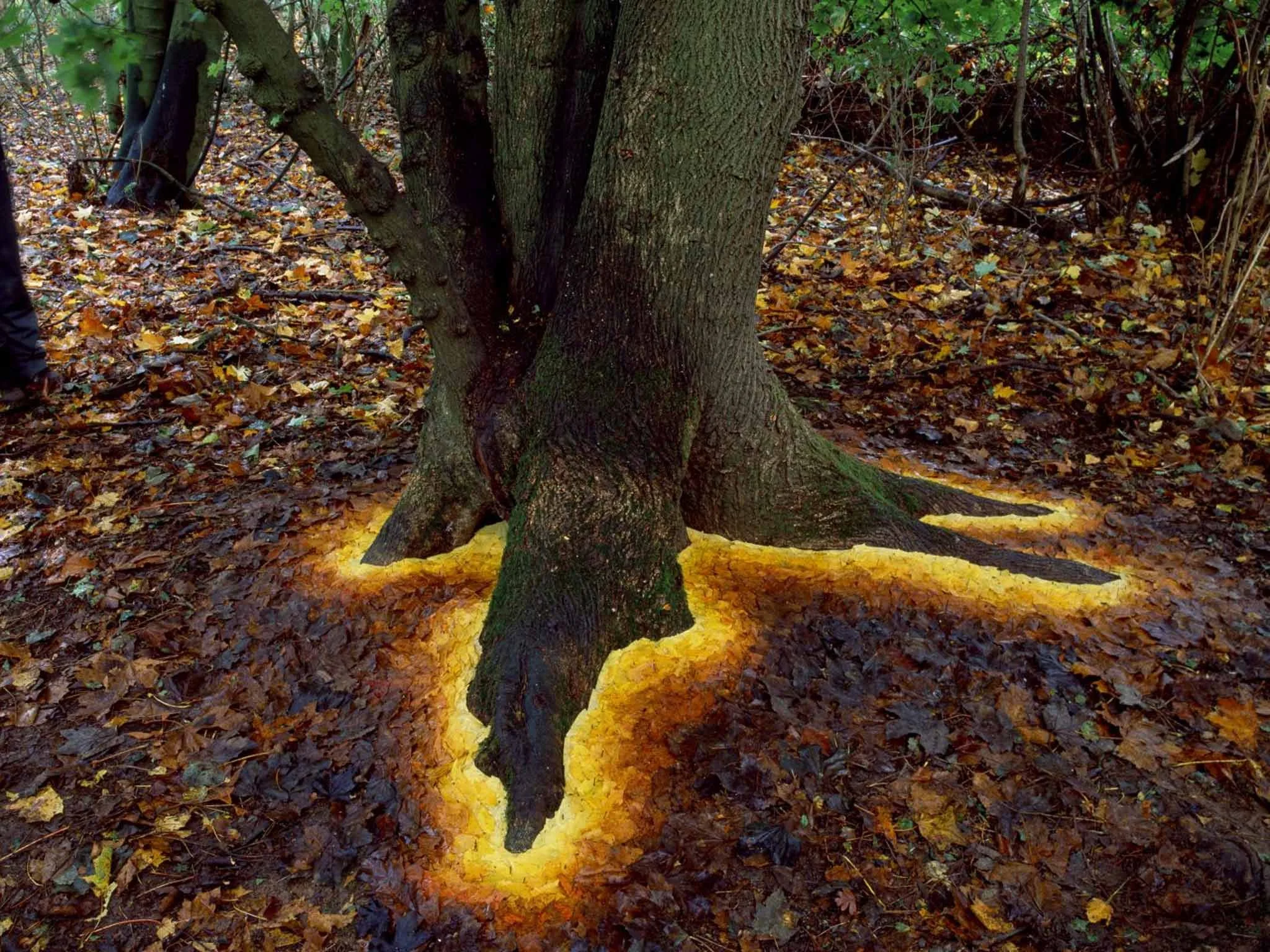
Andy Goldsworthy ephemeral installation
The depth and richness of what is possible if you start looking at the garden are immense. For me personally it has given me an entirely new way of understanding learning design that builds upon what I have learned from the humanist greats, from Pestalozzi, to Malaguzzi & Rinaldi, to Socrates and Kurt Hahn.
Firstly posthumanism allows us to think in terms of kinship and relationship. The idea of children being in the moment and becoming in relation to others (the human, other-than-human, and more-than-human) reframes how we think about designing learning experiences or events. Working in the Cairngorms, where some of my students volunteer and work with wildcats and reindeer, go swimming in the tributaries of the Spey, and play in the forests, brings quite a different framing to understanding what a meaningful learning experience might look, feel, and sound like. Equally, their relationship with the built environment and things as mundane as the A9 all play a role in the way that they exist in the world. Noticing the immanence, beauty, and intensity of these relationships, rather than constantly trying to transcend them through abstract learning goals, is important. Learning is a situated act, entangling us in time, memories, and meaning. It is not the cultivation of abstract virtues that freely float in a neoliberal economy. Even the division of home and school, in our thinking, is a classic humanist act of division. We're not even able to conceptualise the child as a whole, let alone see them in relation to the complex worlds they live within. We're so focused on metrics and measurement that we forget the rich living being it's supposed to be a representation of.
If you look at the history of art, you'll notice that art that was once a celebration of relationship with place and contextual meaning increasingly became a commodity that was traded across boundaries. Paintings in the West were ripped off church walls where they were designed to be displayed and sold from the renaissance onwards (the great revival of ‘humanism’). Now we are perhaps beginning to return to installations that are designed for a place and a set of relationships, such as in Andy Goldsworthy’s work above.
I think the educational pattern is similar. Once, we learned things that entangled us with our world, our relationships, and our sense of our belonging to a landscape - we learned in community and within ecosystems as carers, weavers, hunters, apprentices, cooks and farmers entangled with our material world. Then with industrialisation particularly, we saw learning as something that was ripped from context and was valued because it could move and be sold so freely elsewhere. We were free floating economic ‘Human Resources’, sold and bought like coal, tractors and steam engines.
But perhaps now it's timely to begin to consider how learning helps us belong in the world and form kinship and relationships with what is around us (both now and with a sense of deep time, the generations that came before us, and those that will come after). This might sound fanciful, but in an age of AI, it is also true that, economically, abstract pattern-making thought is not going to be something that can easily be sold. Nor will it be worth sacrificing embedded and meaningful life in order to cultivate it. It is also how all other animals live.
The second thing that I would highlight as significant about posthumanism for learning design is the insight (that ultimately is grounded in quantum physics and work like Karen Barad's Meeting the Universe Halfway) that we create the world that we observe. This is true both in trivial ways and in profound ways. Trivially, many people have always noted that we value what we decide to measure and observe, and this has had an incredibly reductive approach to education. Profoundly philosophically, Karen Barad points out that the universe is in an undetermined state, and it takes on a state at the point at which it's observed. At the quantum level, this is quite literally true: when you observe a particle, it will appear as a particle as an outcome of you observing it, and then return to an undetermined state when you are not looking at it. This is ultimately how things like quantum computers work - they try to hold particles in their undetermined state so they are ‘both/and’ rather than ‘either/or’. In a very practical way, this is the nature of the universe. But many thinkers, including the Taoist tradition (embraced by a large portion of the world) and philosophers like Spinoza and Nietzsche, have noticed it's the same with our values and therefore our learning designs. Posthumanist learning design creates a space for this undetermined richness and questions about how we're situated in time and in relation to the human, more-than-human, and other-than-human worlds around us. It allows us to create a great deal more of what Keats would call negative capability, rather than trying to drive home certainties.
Thirdly, posthumanism allows us to foreground some simple questions, like: What does it mean to live and die well with the human, more-than-human, and other-than-human worlds around us? Rather than see education as a competitive race to develop attributes that can be sold on the open market of employment in a free market that transcends place and relationship, we can be asking: What is a good life in relation to all that is around us and in relation to time, look, feel, and sound like? What is a well-lived life as part of an extensive human, more-than-human, and other-than-human ecosystem?
Fourthly, Posthumanism invites us and asks us to look metaphorically at the soil in the garden and the other plants growing there. Sometimes we can be barely conscious of the world that we live in, and our education can make this worse rather than better. To give a simple soil example, approximately four out of every five animals on the planet Earth are nematode worms. There are 40,000 to 50,000 documented species, and there are thought to be possibly anywhere between half a million and a million species of nematode worm in total. Most people have never heard of them and don't know what they are. They live in the soil around us and are, metaphorically, a really good example of how little we understand the soil that the oak tree grows in and how little attention we pay it. I'm not suggesting we restructure our education system around nematode worms, but what I am saying is our models are deliberately narrow in a race for abstract competencies. We could rethink that purpose, especially as our technology, such as AI, makes those kinds of skills less essential that it is worth sacrificing such a huge range of our other affiliations and sense of being for.
Fifth, it is widely surfaced that we need new relations with the animals and plants around us. Whilst we might struggle to do this because we are still so ingrained in humanist thinking that our needs come first, the sentiment and realisation that we have got something out of balance and wrong is hard to miss. If the oak tree destroys the soil it lives in and everything living around it, from pollinators to fungi that break down nutrients, it too will die. So even if your interests are selfish rather than altruistic beyond our species, it comes to a point where you have to care for the garden, not just the oak tree. Humanist models of education often do this with a patronising change-maker lens that children will magically go out and transform communities they barely understand. A post-humanist lens would bring perhaps more modesty, more kinship, and more care to the ways we live our daily lives before we seek to transform others.
None of this is easy. But I also know that these insights, feelings, and perceptions make for much better learning design. My heart sinks every time I see yet another educational framework with five glossy catchphrases or competencies that are going to transform the world. It doesn't need transforming and you can’t dump that on children as you have lived a life you regret. What it does need is rich experiences of learning to live and die well with the human, more-than-human, and other-than-human entities around us (to find meaning and peace in the way in which we inhabit our childhoods, our adult lives, and our reflections as our time comes to make way for the next generation). I also notice, in very pragmatic ways, that the feelings of acceptance and calm that this posthumanist perspective brings can also transform classrooms. Oak trees flourish in healthy soil. Too often, modern education is getting out the measuring stick of the oak tree and pouring on chemical fertilisers, desperate to try and do anything to make the tree grow faster so that it can later be cut down for wood. This is not the way. There is a better, more peaceful, richer, more thoughtful, more compassionate, more caring, more kind way in which we can design learning.