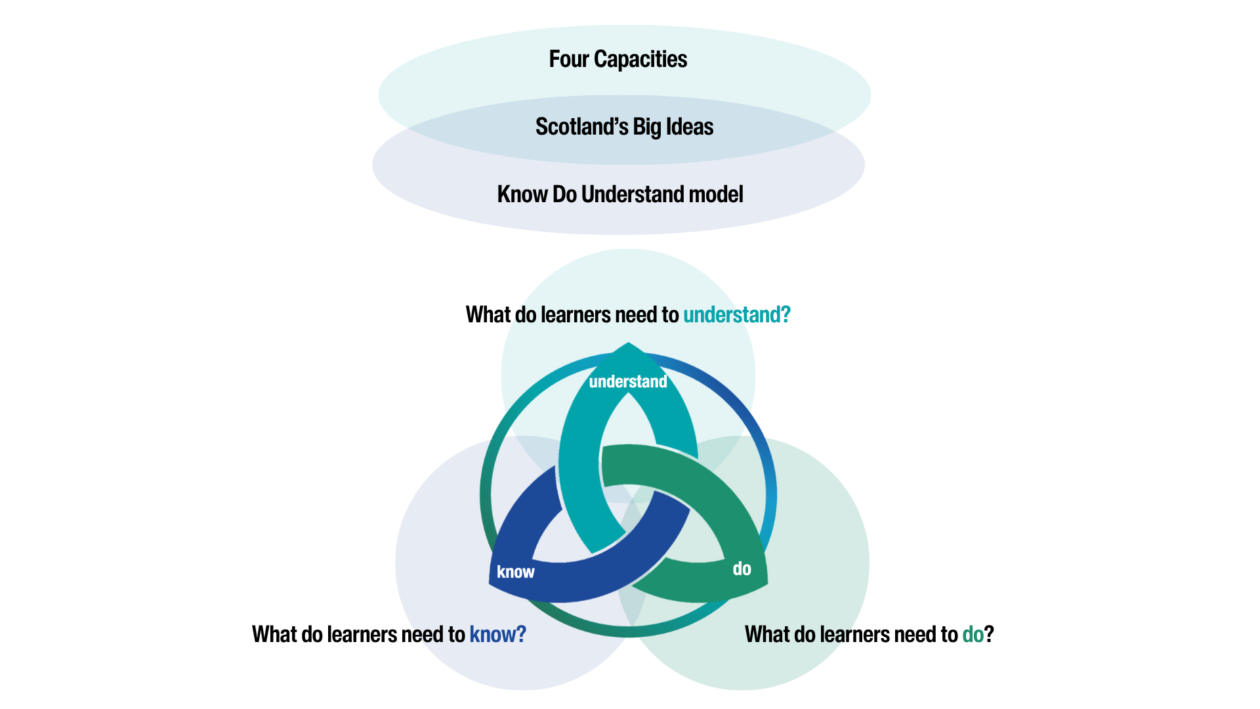
The first word in the description of Scotland’s curriculum model is ‘know’ and yet still for many questions abound about what the role of knowledge is in such a model, and there have even been anxieties from outside that is it not ‘knowledge rich’ enough. The anxieties come from a place of uncertainty, rather than anything else, and in this post I want to explore the profound role that knowledge plays in Scotland’s new curriculum.
Humans come into the world and get knowledge of things. What they notice and know plays a profound role in not only learning but even our development. To give some examples, if we do not learn ‘knowledge’ of musical notes and the skill to identify them in very early childhood, we will develop so we never can - we will never have ‘perfect pitch’. Our brains will develop so we literally cannot ‘hear’ what a note is without another named note to guide us (Ed. Ericsson, K. A., 2018). Similarly Taxi drivers’ hypocampus in the brain grows when doing ‘The Knowledge’ in London, memorising streets (Jabr, F. 2011). So knowledge is not only fundamental, it can even change our physical brain and the way we experience the world.
The point about knowledge is that on its own it is a bit useless beyond an extremely narrow context. To give an example. I might know that during the Dutch Tulip bubble, (https://en.wikipedia.org/wiki/Tulip_mania) from 1634 - 1637 a single tulip bulb at one stage was the same price as a modest house. A bag of bulbs from B&Q would have bought you a small village back then. I find this fascinating, and my parents and family used to have to ‘tolerate’ me as a child constantly saying ‘did you know that…’ as I collected random trivia. I love that knowledge. But you can’t do much with it.

What humans are extremely good at, is spotting patterns. Some humans are exceptionally good at it, and I enjoyed Cambridge Professor Simon Baron-Cohen’s book The pattern seekers which looks at the extraordinary contribution autistic people have made to human understanding due to their curiosity about patterns. It took someone like Adam Smith, Antoine Augustin Cournot and Alfred Marshall to spot the pattern that…
All else being equal, prices tend to rise when demand exceeds supply and fall when supply exceeds demand, moving towards a market equilibrium where quantity demanded equals quantity supplied.
Now that is useful. And it explains not just the Tulips or why some Pokemon cards are worth over 1 million dollars, despite having no obvious use, but it explains every price that young people might see around them, what they might get paid if they have more specialised useful skills and why the housing market is hard right now. They can also model and predict pricing and solve problems using that relationship. It is what we call an understanding.
The role of knowledge is not to help you win pub quizes, much fun though that is. The role of knowledge in a ‘know do understand’ model is to help you form powerful understandings that help you navigate the world, make sense of what you know and apply it to future challenges or contexts.
If knowledge was a goal in itself, we would just have to memorise random stuff, basically for the sake of it, leaving out the thinking. That would be reassuringly simple, and easy to test, but pretty pointless. Someone like me might quite enjoy some of that, but there would be no point in our rapidly changing world where a ‘set body of knowledge’ won’t get you far out the harbour of life’s journey. In reality that is not even what ‘knowledge rich’ models actually do.
In a ‘know, do, understand’ model, we explore and learn (yes that does mean actually ‘know’) the knowledge, but in order to see patterns and form understandings about how the world works. A bonus is that ‘well organised knowledge’ that is arranged in schema is actually a lot easier to remember (Bransford, J. D., Brown, A. L., & Cocking, R. R., 2000) and again the ‘knowledge rich’ tradition would also make this point strongly.
So what does that look like as curriculum?
An English and Literacy statement might generically look like this
•Understand: writers can use narrative perspective to create feelings of empathy and proximity to characters
•Know: Examples of first-person narrative and third person narrative which create feelings of proximity to protagonist.
•Includes: unreliable narrators, free indirect speech:
•Notes: Could be addressed through poetry or prose. Could be part of interdisciplinary learning about influence in political story telling in persuasive texts or propaganda in social studies or RME.
Now here you can see the beauty of the model. I have complete clarity about the knowledge - the learners must know examples of narrative that create proximity through first person and third person narrative. But I can also choose which case studies to use. James Joyce’s Dubliners is famous for free-indirect speech, so that comes to mind, but so do Browning dramatic monologues. Students would have to know these case studies in order to begin to understand the pattern. So this is not an ‘anything goes’ curriculum. But… and it is an important but…if I want to represent the lived experiences of students, I can also ask them to bring in their own examples of narrative perspective from texts they love. I can do an interdisciplinary unit looking at a National Progression Award in computer game design to see similarities and differences in characterisation and narrative position (e.g. first person games, vs. strategy games). I can look at Burn’s Tam o’ Shanter, and I could look at Rockstar Games’ Grant Theft Auto. I can reflect Shetland or The Gorbals in my texts.
The beauty of the model is that clarity about knowledge co-exists with intellectual and cultural flexibility, and the ability of reflect the culture and importance of the context. Scotland has a particular history that means it values the autonomy to decide rather than be told whose culture and language are important, whose knowledge is ‘powerful’ and whose is ‘marginal’. Communities want the ability for learning to be relevant and meaningful.
A good frame for thinking as a teacher about what knowledge is ‘powerful’ is not to just dictate that from some political centre, but to think of the knowledge case studies as being ‘mirrors, windows, doors’ Bishop, R. S. (1990).
All students should have experiences of seeing their lives and interests represented in the curriculum. These are ‘mirrors’. That might be in this case a book they have chosen or a graphic novel or game they feel very comfortable with, or a local author writing about their community, or their heritage particularly for new Scots. This makes us feel we belong and can relate to our learning.
But we should also have experiences that make us understand others’ perspectives. This might be knowledge from a different time or context that is a bit further from our normal life. The example of Dubliners here - what did if feel like to be a servant girl in Dublin who was poorly educated at the turn of the nineteenth century? Why did James Joyce write from her perspective indirectly? Why did he write that book when he was actually living in exile in Italy at the time near Trieste?
And we should also have sliding doors that take us into a different world from ours. Perhaps examples of Japanese writing like As I Crossed a Bridge of Dream that allow us to enter the world of a Japanese lady at court a thousand years ago and recognise how similar and how different our humans lives can be.
And when we say ‘know’ we genuinely mean ‘know’. Not superficially glance at; not hear the name of; not be near in the classroom. But genuinely learn and internalise important examples of knowledge; but not for their own sake, but to help us make sense of the world. You can read more about this in AAA+ the Hessciarn Guide to Teaching for Understanding - how to teach big ideas.
The key takeaways are: now is a good time to plant Tulips for next year. Pokemon are very collectible… no, no, sorry let’s try that again focused on knowledge and understanding.
Key takeaways : knowledge is powerful, important and central to the new model. Not only is there a strong base in knowledge, it is there for more reasons than simply to win pub quizzes (although it might help with that too). It is there to help us see patterns, form schema and make sense of the world. Knowledge can be thought of ‘mirrors, windows, or doors’ and can make a huge difference to engagement and relevance in class in my experience. It works in a Celtic knot… and in a future blog post I’ll write about skill.
Baron-Cohen, S. (2020). The pattern seekers: A new theory of human invention (1st edition). Allen Lane.
Bishop, R. S. (1990). Mirrors, Windows and Sliding Glass Doors. Perspectives: Choosing and Using Books for the Classroom, 6(3 Summer).
Bransford, J. D., Brown, A. L., & Cocking, R. R. (2000). How People Learn: Brain, Mind, Experience, and School: Expanded Edition (2nd edn). National Academies Press. https://doi.org/10.17226/9853
Jabr, F. (2011). Cache Cab: Taxi Drivers’ Brains Grow to Navigate London’s Streets. Scientific American. Scientific American. https://www.scientificamerican.com/article/london-taxi-memory/
Ed. Ericsson, K. A. (2018). The Cambridge Handbook of Expertise and Expert Performance (K. A. Ericsson, R. R. Hoffman, A. Kozbelt, & A. M. Williams, Eds). Cambridge University Press.